
What is LMS?
Smartshow LMS — the spiritual successor to Jinx! 2.4. Same workflow, modern engine, the missing bits filled in. Now on Windows, macOS and Linux. A live work-in-progress, built in public with the help of testers like you.
The short version
LMS is the LED matrix control software the lighting community needed once Jinx! stopped being a moving target. Jinx! 2.4 still works, but the engine is frozen — closed binary, no updates, codec and renderer limits that can't be lifted by anyone outside the original project.
So Lee James and Bob from Smartshow Lighting made the call: stop trying to patch a frozen target, and rebuild Jinx! 2.4's exact workflow on a modern stack — same soul, new heart. Faithful to what everyone loved about Jinx, with everything that was missing finally there.
Modelled on Jinx 2.4
The look-and-feel is deliberate. If you've ever run a club, a wedding, or a DJ booth off Jinx, you'll find LMS within ten seconds:
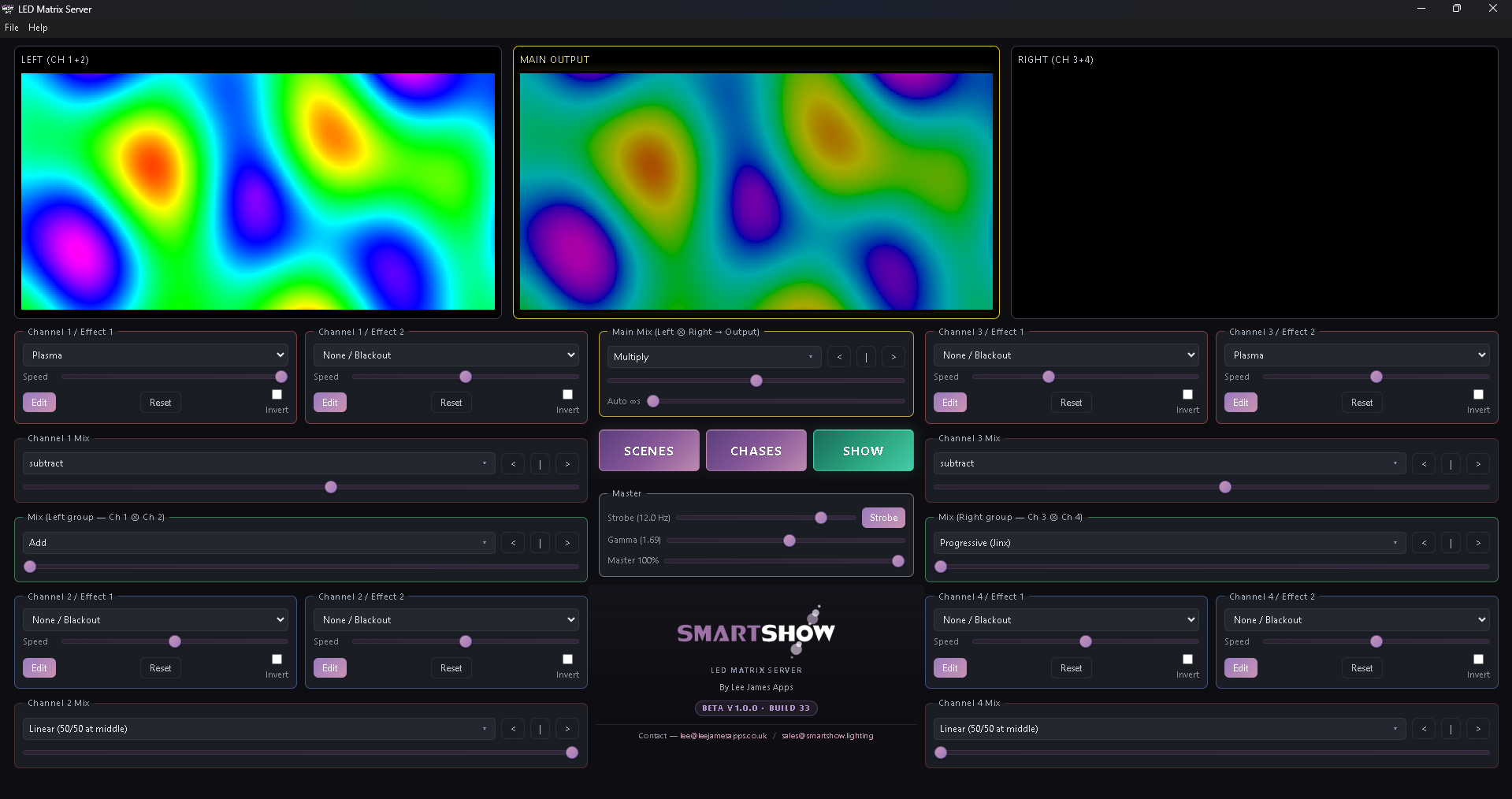
- 4 channels × 2 effect slots, channel mix, group L / group R / main mix
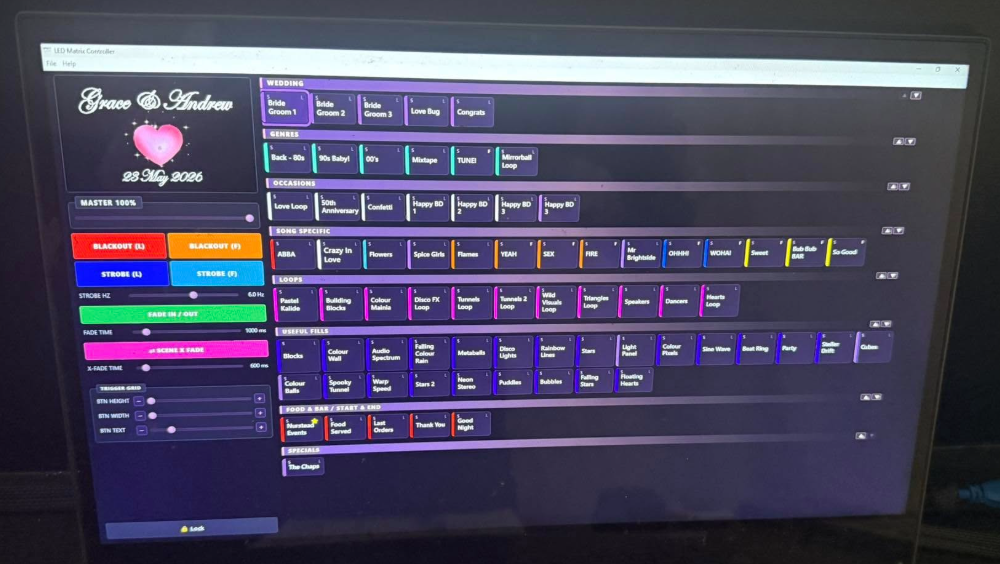
- Same Scenes + Chases + Show Mode triad — snapshot the whole graph, sequence the snapshots, trigger from a button grid
- BLACKOUT and STROBE in (L)atch + (F)lash flavours — the same gestures your fingers already know
- Master with Strobe Hz, Gamma, Master fader; main fader Auto Speed
- Per-button Pill / Background / Text colours, sections, Edit-mode hide/unhide
What Jinx never had (and LMS does)
The whole point of rebuilding rather than maintaining was a chance to finally land the features the Jinx community had been asking for, for years:
- RGBW everywhere — every colour control on every effect has the white channel. SK6812-RGBW / WS2814W users no longer have to fudge it.
- Six output protocols simultaneously — Art-Net + sACN + DDP + TPM2.net + Serial DMX (ENTTEC USB Pro / DMXKing) + Glediator. Run them all at once into different parts of the rig.
- Per-row Output Patch — route different slices of the framebuffer to different controllers via different protocols, on different IPs, with different cabling, with individual on/off toggles for testing.
- Per-section NIC selectors on dual-homed machines (input LAN ≠ output LAN).
- Tablet Remote — open a URL on any iPad / Android / phone, get the trigger grid wirelessly. Press-and-hold flash buttons that actually work on touchscreens. mDNS auto-discovery (
lms.local). Add to Home Screen and it's a proper app icon. - Kiosk lock + PIN — engineer sets up the install, ticks "Lock on next launch", end-user only sees the trigger grid until the PIN's entered.
- External control IN — Art-Net + sACN DMX-in, OSC, MIDI Clock IN+OUT, MTC, MIDI feedback OUT. Drive LMS from a lighting desk, DAW, TouchOSC, or hardware controller.
- 16-bit dimming — optional 16-bit DMX output with γ=2.2 curve. Smooth low-end fades 8-bit can't deliver.
- In-app updater — new builds roll out automatically.
- Built-in audio reactive effects — Spectrum Bars, Beat Pulse, Beat Rings, VU Meter, all driven by Web Audio FFT. No external DJ software round-trip.
- WebGL-accelerated effects — plasma, gradient, fire, kaleidoscope run on the GPU. Big matrices stop being a bottleneck.
Everything Jinx 2.4 could do, LMS can do. Plus a list of things Jinx couldn't do that you'd never go back from once you've used them.
The Smartshow partnership
LMS is built by Lee James Apps in partnership with Smartshow Lighting. Bob (Smartshow) brings the industry knowledge — what real installs need, what beta testers want, what the LED hardware actually does at the physical layer. Lee writes the code. The pairing has caught more bugs in a fortnight than either of us would have hit alone.
Every bug fix you'll see in the release notes traces back to a real install — a wedding kiosk where the matrix size change wiped the patch, a club rig where the chase button colour wasn't applying, a touring rack where the master streaming gate was in the wrong place. The list keeps growing because testers keep using it for real shows.
Where LMS is at
Stable and public since 1.0.1 (August 2026) — the current release is 1.3.0, free for Windows, macOS and Linux at smartshowlms.leejamesapps.co.uk. Development is still fast: new features land with each release, a few are marked beta while they prove themselves, and feedback here shapes what comes next. Saved projects auto-migrate across versions; nothing you build today gets thrown away.
You'll find:
- Rough edges in UI placement (we're still finding the right home for some controls)
- Features that work but aren't documented (Help page is being filled in)
- Runs on Windows, macOS and Linux — all three, each with in-app auto-update. The Mac build is Apple-signed and notarised.
- The Windows touchscreen press-and-hold flash bug — a documented driver-level limit on specific hardware; works fine via mouse, works perfectly via the tablet remote, breaks on the Windows touchscreen path. We've tried eight workarounds; an iPad / Android tablet is the answer.
What's coming
- Multi-zone matrix topology — stacked panels with their own cabling, triangles, text signs, the install shapes Jinx could never handle properly. Design under review; aiming to land in the next few weeks.
- Native iPad app — the web tablet remote is the stepping stone; a real Swift app via the Apple Developer Program is on the roadmap.
- Photo overlay positioning (Brian Hofschröer's idea) — drop a photo of the install, place LEDs on it visually. Phase 2 of the topology rebuild.
- Code signing for Windows — to retire the "Windows protected your PC" SmartScreen prompt on first install (the Mac build is already notarised).
- Commercial release — timeline TBD. The plan is LMS stays free-to-tester forever; eventually a paid tier may exist for additional enterprise features. No subscription nonsense.
How you can help
The most useful thing you can do is use LMS on a real install and tell us what breaks. Bug reports beat feature requests; feature requests beat silence. Every category on the feedback board gets read; Lee gets emailed on every new post.
Specifically:
- If something behaves differently than Jinx, tell us — we may have intentionally changed it (please challenge that) OR we may have a regression we don't know about
- If a feature is missing that you'd genuinely use, tell us — we'll prioritise things multiple testers ask for
- If LMS crashes, hangs, or eats memory — open the Help → DevTools console (or set
LMC_DEVTOOLS=1env var), screenshot the error, paste it on the feedback board - Tell other lighting people who run Jinx — we want this community alive
LMS is Lee James Apps' open take on the Jinx! workflow. In partnership with Smartshow Lighting.